Why Building AI for Multimillion-Dollar Operations Takes More Than Language Models and CoPilots
As language models and tools like Microsoft CoPilot make AI development more accessible, energy and heavy industry teams are increasingly building their own applications. In S&P Global’s 2026 research, nearly half of utilities and oil and gas respondents said their organizations had developed AI capabilities internally during the previous year.
At Bolo, we see this experimentation as a positive development. The people who know an operation best should help shape how AI supports it.
But making AI dependable enough to keep operations safe, protect uptime, and preserve margin is a larger undertaking. Connecticut’s recent request to review utility AI use illustrates the stakes. State officials are calling for scrutiny of AI across essential operations, citing false information and forecasting errors, including a California wildfire that grew to ten times the size predicted by a utility’s AI forecast.
Bolo works with engineers and operators to address these risks as their companies expand their use of AI. Our work centers on three principles that in-house efforts often overlook:
Language models can help engineers interpret questions and records. But recommending changes to multimillion-dollar equipment requires understanding its physical behavior, operating limits, and field conditions. Bolo solves for this by orchestrating LLMs, physics-based models, machine learning, and field expertise together in one powerful system.
With one oil and gas operator, we’re applying this approach to increase production and extend pump run life from wells using electric submersible pumps (ESPs). Multiple Bolo agents examine production data, sensor trends, pump physics models, and advanced machine-learning analyses, and findings from one analysis inform what the others examine next.
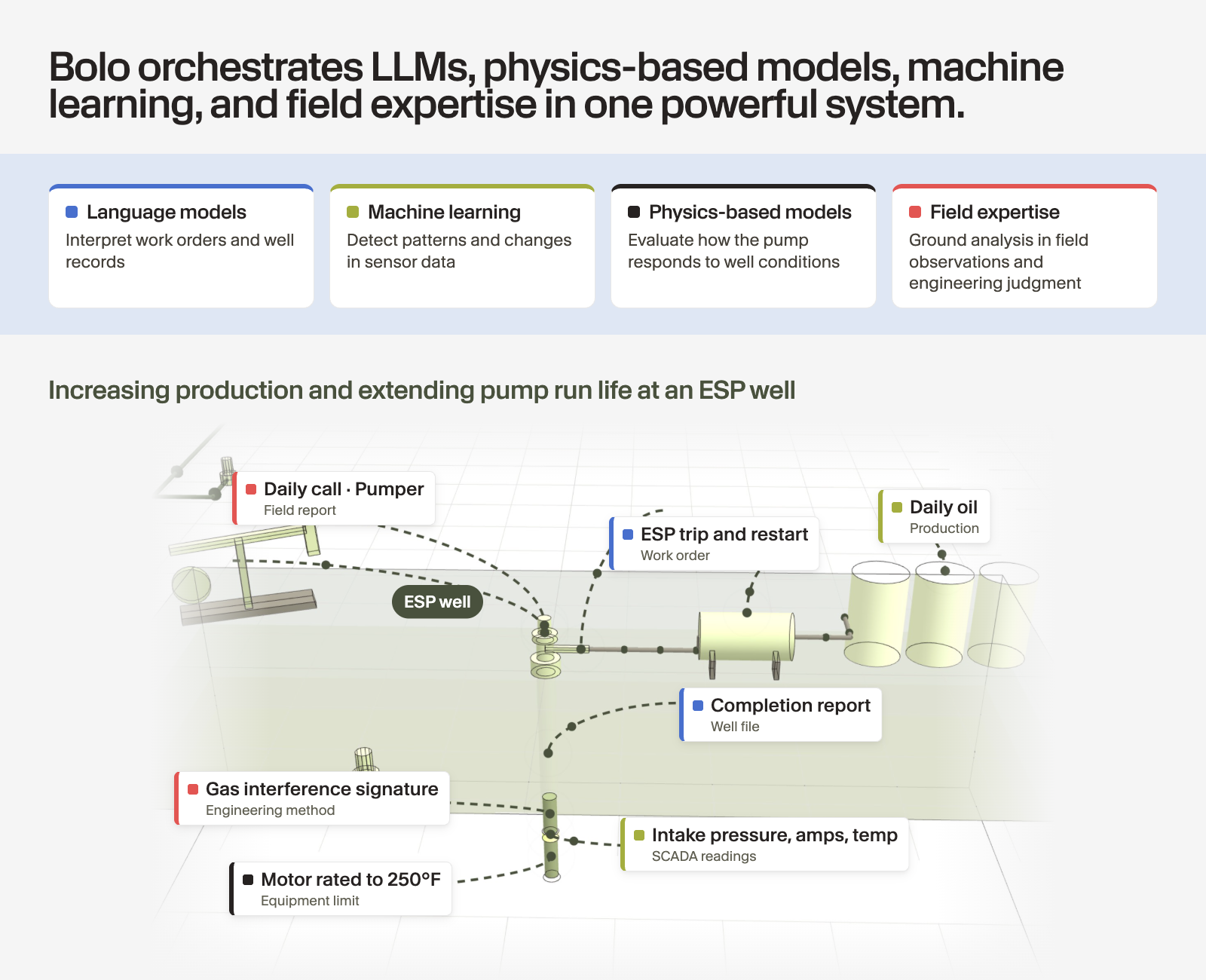
For example, when agents identify an opportunity to increase production, they check whether the pump can handle the increase, using pump models to assess its limits and sensor readings to understand how it’s behaving in the field. Recommendations also account for conditions such as repeated gas locking, elevated motor temperatures, and excessive motor loads.
We build this system alongside ESP specialists with experience operating thousands of wells, including assessing installed equipment and surface setups. ESP expertise informs how agents investigate, which readings warrant scrutiny, and how to interpret a well’s response after a change. Because no two wells operate exactly alike, human expertise is indispensable in guiding how Bolo recommends changes.
For AI to support critical decisions in heavy industry, it needs to remember what has happened across the operation, not just what one person told it. Language models and generic AI tools can connect to company systems and remember past conversations. But understanding cause and effect requires context across people and systems: what changed, why a decision was made, and how the operation responded. Bolo builds and maintains that living memory of the operation.
For example, at one oil and gas operator, changes in water cut prompted an investigation into reservoir behavior. But conversations with field personnel revealed another explanation: they had changed a pump. Interpreting the readings required understanding that intervention and the well’s response before drawing conclusions about the reservoir.
Today, Bolo’s voice agents capture daily updates from the operator’s pumpers and other field personnel, connecting that knowledge with each well’s equipment and production history. Each intervention and its outcome adds to a shared memory of the field, giving AI the context to investigate cause and effect: whether a new production change could be explained by recent field work, mirrors how the well behaved after an earlier intervention, or calls for a closer look at the reservoir. Engineers can build on what the whole team has learned rather than reconstructing that history for every investigation.
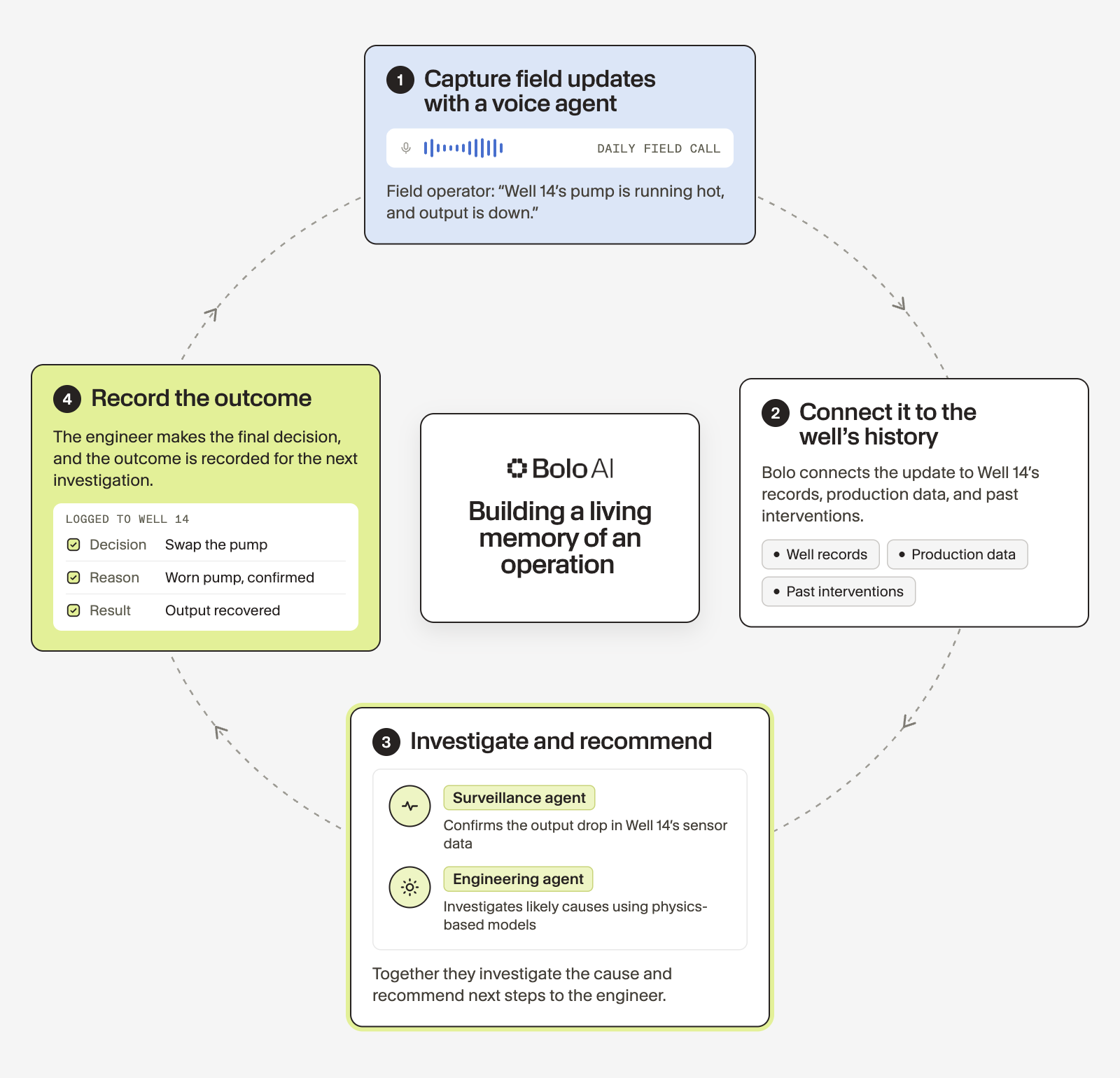
That memory grows as teams take on new problems. A team might start by using Bolo to identify underperforming wells and track field work in one place, a shared view we call a control tower. If the team then wants to use AI to improve pump performance, Bolo can build on the well histories and past interventions already captured, using pump models and sensor data to investigate what is limiting performance. From there, the team can use AI to improve production across the field, drawing on injection history and reservoir physics to assess where changes could deliver the greatest benefit. Bolo maintains this memory alongside customers, so each new application builds on the context and experience of the last.
Bolo works with engineers to build evaluation suites specific to their equipment and processes. A test might ask an agent to recommend a pump speed, then assess that recommendation against equipment limits. Another might provide incomplete production records and test whether the agent identifies the gaps before judging a well’s performance.
At a Fortune 500 utility company, Bolo built evaluations around fleet-wide asset investigations covering critical equipment like transformers, circuit breakers, and batteries, that typically require days of exporting and reviewing readings. We paired investigation questions with expected answers, specifying the records the agent should retrieve, unusual readings it should flag, and clarifying questions it should ask. In a recent test, the agents achieved 98% accuracy in those evaluations.

These evaluations become more important as new language models arrive since these models are inherently probabilistic. Updating the underlying model can change answers an agent previously got right. Bolo reruns evaluations to identify answer drift and address errors before an updated model is used in operations. Our forward-deployed engineers build and maintain these tests alongside customer teams, so engineers can provide feedback without taking on the ongoing testing work.
AI is becoming easier to build, but decisions about multimillion-dollar assets carry consequences for safety, production, and profitability.
Asking language models or generic AI assistants to analyze production records can surface useful insights, but often leave your engineers to establish whether a recommendation accounts for the latest field intervention, the pump’s operating limits, or an approach that already failed on that well. Unless those capabilities are built into the application, engineers have to reconstruct the context and check the reasoning each time.
In these environments, what makes AI dependable is what surrounds the language model: the orchestration grounded in physics and field expertise, the knowledge it retains, and the evaluations that establish whether recommendations hold up in real operating environments.
Get in touch to explore how Bolo’s custom solutions and AI advisory services can help your team strengthen existing applications and take on more complex operating decisions.