One Query Surfaced Four At-Risk Transformers and Prevented an $8M Loss
When you’re managing a large fleet of assets that provide power for millions of customers, down time is something you can’t risk. But for one Fortune 500 electric and natural gas utility, there wasn’t enough time in a day—or an advanced enough tracking system—for reliability engineers to proactively service them all, or even see which assets were at risk. The utility’s team was left wondering what their lack of fleet-wide insight would cost them.
A supervised pilot with Bolo revealed the answer: four transformers showed dangerous dissolved gas readings that had gone unnoticed for months, surfacing warning signs they may have otherwise missed.
The utility company’s reliability engineers are responsible for thousands of assets across a grid serving 2.4 million customers throughout Missouri and Illinois. They're deeply skilled at what they do, but they're also stretched thin.
Transformer dissolved gas analysis (DGA) data exists in their systems, and their team possesses the expertise to interpret it. But synthesizing that data into fleet-wide insights requires manually stitching together exports from multiple systems—a process that takes roughly eight hours when done comprehensively. That’s on top of already demanding responsibilities for reliability engineers, including responding to outages, managing scheduled maintenance, handling compliance requirements, and supporting capital planning. Proactive fleet-wide DGA sweeps are valuable, but they’re often deprioritized because the team is busy doing the other critical work that keeps the grid running.
The result is a gap no one wants but everyone understands. Comprehensive analysis happens periodically rather than continuously, so issues are caught only when they escalate instead of proactively when they're still manageable.
The utility company’s team recognized this trade-off and wanted to resolve it. They partnered with Hitachi Energy, whose APM Health software already housed their asset data, and brought in Bolo to add a natural language query layer that could cut eight hours of manual synthesis down to two minutes.
Bolo configured data connections in under two weeks. Then came the supervised pilot on the actual fleet data in a test environment.
A substation maintenance engineer asked a simple natural language query: show me transformers with acetylene spikes across my fleet for the last two years. Within minutes, the system surfaced results. Four transformers were flagged with readings that warranted urgent attention, with one reading so high it was almost off the charts.
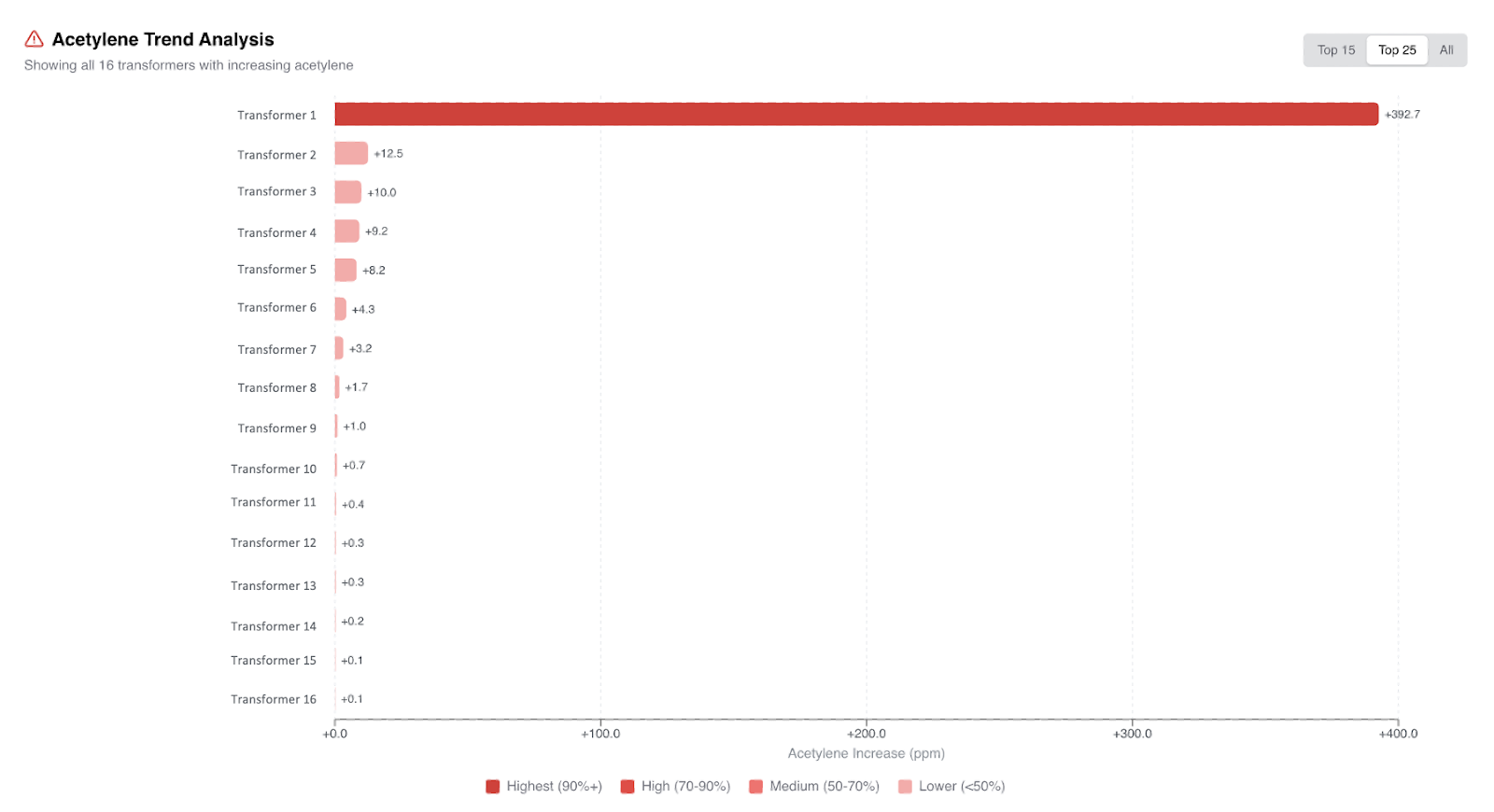
The utility team's reaction was immediate: "If that value is real, that transformer should not be in service."
They called the engineer responsible for that asset on the spot, and an emergency oil sample was scheduled that day to investigate further.
When asked how they would have found this issue without Bolo, their answer was direct: "It would have been almost impossible."
Within one day, the utility team had reviewed the full list and taken action. The three additional transformers that had shown increasing acetylene received follow-up. Two were addressed with updated samples and additional testing, while one needed a new sample collected. The rest of the fleet-wide results showed only trace acetylene levels, within normal operations.
The cost of the old system became clear: If Bolo hadn’t surfaced the acetylene discrepancies, the Fortune 500 might have been managing a $8M loss instead of performing routine maintenance.
With a prioritized view of their entire fleet, the utility company is able to identify potential multi-million dollar losses in at-risk assets. The team is well-equipped to separate genuine risk from the background noise that comes with routine operations. And they can do it in minutes instead of days.
What once took eight hours now takes two minutes, 240 times faster. But the most significant transformation is the visibility that makes proactive monitoring possible at scale.
Before, fleet-wide DGA analysis was a periodic, resource-intensive project. Issues flew under the radar until they became emergencies.
Now, the same analysis runs on-demand, enabling proactive monitoring at a cadence that had been impossible. The utility company has seen impact across:
These outcomes demonstrate how GenAI in industrial operations can offer ROI beyond incremental productivity gains—it can also fundamentally change what's operationally possible.
Bolo began working with Hitachi Energy in 2025 to integrate GenAI capabilities directly into their APM Health software. The aim was to help utility customers unlock insights trapped in their asset data without requiring new dashboards, data migrations, or workflow changes.
The result is APM Smart Query, a Bolo-powered capability that enables natural language queries against complex operational databases. Engineers ask questions in plain English, then the system translates those queries into the appropriate database calls, synthesizes results across sources, and returns answers in context.
The integration is built on Bolo’s context layer, which connects customer data to proprietary AI agents. This allows accurate reasoning over sophisticated industrial schemas—in Hitachi's case, databases with 23 tables, up to 33 columns per table, and tens of thousands of records per asset type. In testing, APM Smart Query achieved a 93% pass rate on user acceptance test cases covering simple search, anomaly detection, comparative analysis, and recommendation support.
The utility company's deployment represents customer validation of this work. The two-week timeline from kickoff to working pilot reflects an architecture designed for rapid deployment on top of existing systems.
The supervised pilot validated the value—now the utility company is moving to deployment. Their reliability engineers will have direct access to query their fleet data on demand.
Beyond acetylene detection, the team is expanding into additional workflows, including SF6 reporting for compliance, which previously required manual assembly from multiple systems and engineers. With Bolo’s APM Smart Query, a complete report is just a natural language prompt away.
For utilities and industrial operators evaluating GenAI, the Fortune 500's experience offers a clear window into what ROI can look like: the technology can deliver measurable operational value in mere weeks, on production data, with real consequences for how teams manage critical infrastructure.